Written by: William Molano, Social Promotion & Livelihoods Project Manager at Fundación Capital.
Climate change is a global challenge that affects all of us. Its effects are more severe for communities in poverty and vulnerability, who lack the resources to adapt to extreme climate phenomena such as droughts and floods.
It is estimated that climate change will lead 132 million more people into extreme poverty, disproportionately impacting women who, in many cases, depend on subsistence agriculture (Jafino et al. 2020) /1. These events not only put their lives and livelihoods at risk, but also aggravate food insecurity and generate social tensions that might result in an increase in Gender-Based Violence (GBV) situations. Furthermore, transition policies to carbon-neutral economies, although necessary, can negatively affect vulnerable populations due to shocks in the labor market and increases in the prices of basic goods (ILO 2023B) /2. These direct and indirect impacts of climate change demand a comprehensive and robust social policy response.
Economic inclusion programs with a Graduation approach are strategically designed to address the complex interrelationship between poverty and climate challenges. These programs offer a set of multidimensional and coordinated interventions that support individuals, households, and communities in their efforts to increase their income and assets. This approach has been shown to have lasting effects on poverty reduction /3, consistent across diverse contexts /4 and sustainable for up to 10 years /5. By integrating climate resilience and conservation into these programs, we improve socioeconomic conditions, and also strengthen the capacity of communities to adapt and thrive in an increasingly uncertain environment, playing a crucial role in eradicating poverty.
| Learn about Fundación Capital's Graduation program
Aligning policies, promoting intersectoral collaboration, and merging climate objectives with those of poverty reduction are key to achieving climate resilience and its eradication. International development agencies are already adopting a climate-centered development approach, which has substantial funding (Naran et al. 2022) /6.

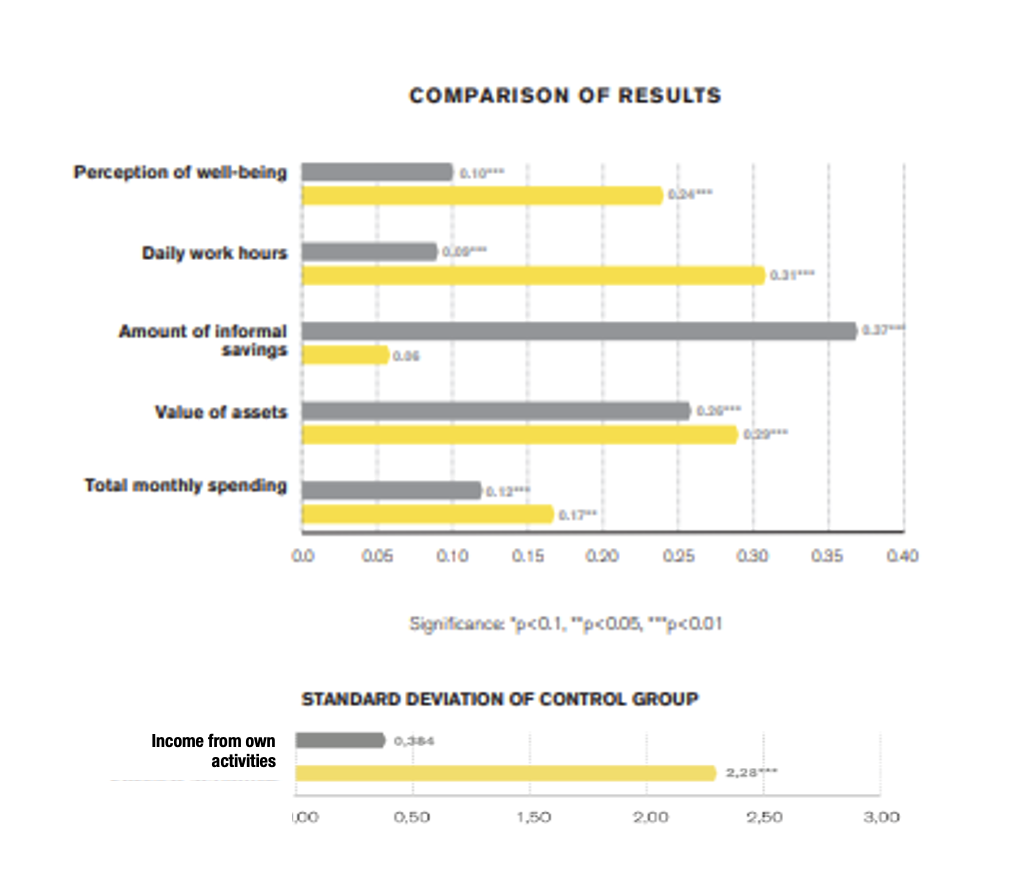
A successful example of how Graduation programs can strengthen climate resilience is reflected in the findings of an RCT conducted by Universidad de los Andes, which evaluated the “Emprendiendo Una Vida Mejor” (EVM) program, implemented by Fundación Capital /7 in partnership with the Government of Honduras. One year after the program’s completion—during a period marked by severe drought, two hurricanes, and the pandemic—participants showed stronger socioeconomic indicators than the control group. They experienced increases in hours worked, improved perceptions of gender equality in roles, growth in total asset value and formal savings, as well as improvements in food security and self-perceived well-being. These results confirm increased resilience among participants in the face of external shocks and reinforce the evidence that our Graduation programs are effective in addressing climate change and its impacts on populations living in situations of greater poverty /8.
At Fundación Capital, we integrate climate action into our economic inclusion programs, transforming the fight against poverty into an opportunity for communities to strengthen their adaptive capacities and become active agents of environmental protection and sustainable development. For example, in Mozambique, one of the countries most affected by the climate emergencies, we implemented a Graduation program targeting 5,000 families, in which we trained focal points in each community in climate-resilient agricultural practices, in order that they could replicate and disseminate this knowledge in their respective communities.
How to achieve effective integration?
The Partnership for Economic Inclusion (PEI) of the World Bank has proposed a framework to carry out this integration at scale. This framework highlights that combining adaptation, mitigation, and conservation strategies within Graduation programs is essential to create sustainable, long-term solutions. By integrating these elements, interventions not only respond to immediate challenges but also build a more resilient future for communities.
An intersectional approach is key to ensuring that solutions are inclusive and equitable, considering the differentiated realities of gender and the particularities of local communities, especially indigenous peoples who, with their deep knowledge of natural environments, play a crucial role in resource conservation. Incorporating conservation practices within Graduation programs, such as riverbank protection, organic agriculture, and reforestation, not only protects biodiversity but also creates new opportunities for sustainable livelihoods.
As part of our economic inclusion strategy for the next five years, at Fundación Capital we propose initiatives focused on co-design with communities, especially with women, to protect and regenerate ecosystems. We differentiate ourselves by offering solutions that not only conserve biodiversity through collaborative initiatives but also generate sustainable income and reduce violence. We value women's knowledge and the care economy, protect strategic ecosystems, and increase their assets through ecological means, transforming social norms to promote their equitable participation in decision-making on climate and the use of natural and economic resources. We offer a direct and effective approach that prioritizes the transfer of sustainable resources and generates environmental and social value, thanks to our commitment and participation in the search for real solutions.

In the countries where we work, this vision materializes through initiatives that strengthen social protection systems through Graduation approaches that integrate climate resilience. These actions seek to increase people's resilience and well-being, promoting environmental conservation and biodiversity. Additionally, we seek to inspire government action and collaboration for climate resilience, demonstrating the potential of simultaneously integrating an approach to address environmental and socioeconomic challenges.
By integrating climate resilience and conservation into our programs, we not only combat poverty, but also sow the seeds of a sustainable future, where people and the planet can thrive in harmony. True transformation begins when communities become protagonists of their own development.
This article was originally published on LinkedIn on September 2, 2024.
To learn more about our initiatives, follow us, write to us at [info@fundacioncapital.org](mailto:info@fundacioncapital.org), or share.